(this is page 52 of 121)


Latest

Ned is blogging about the fiasco that is the sudden service termination of Rael Dornfest's, IWantSandy.com, something that is likely to get more attention as more of these Web 2.0 experiments fizzle.

I've had non-geeky people say to me in the past that they refuse to try all of these shiny new web services for exactly this reason: not knowing whether the service is likely to have staying power. With the collapse of the blind faith "make something people use and everything else will take care of itself" mantra of the last few years, I think that even bleeding-edge users are going to start to become more discriminating about the underlying model for sustainability for any given service that they might think about investing their time and data into.

This doesn't mean that everyone is suddenly going to become adept as an Internet investor at understanding business models, but it does mean that more people will come to expect to at least understand the vague outlines of how a service provider is intending to make money.

At Tabblo for instance, we were always very clear that the service was free (including storage, templates, sharing, etc.) because we were hoping that people would consider their creative investment worthy of a physical artifact. And I imagine that if we were still independent today, we'd have no qualms about "nudging" the users of the service towards transactions for those money-making products.

Making money is such a pesky nuisance on the web— too bad it's the only insurance against getting clipped by a change of temperament on the part of investors or entrepreneurs.

Comments Permalink

Though I was initially excited to read Gladwell's new book, Outliers, finishing it last night left me with the feeling of just having consumed bad fast food. It's hardly an insightful book and seems to meander all over the place, jumping from random story to personal anecdotes without a worry about ripping the reader around on a random walk down the course of a half-baked argument. What is more, it seems that the already thin book is populated with a number of multi-page charts that reminded me of when I would go crazy with Word charts in high school to beef up my anemic papers with extraneous information that I hope would make me seem more "studied."

The best part of the book is the factoid that it takes 10,000 hours for anyone to truly master anything (assuming that they are working hard and receiving feedback along the way) which roughly translates to about a decade in a normal person's life. This is a good yardstick to keep in mind as we go through life dabbling in new things: after all, we might at most get 4-5 chances throughout our lives to get truly good at something.

Outside of that, the other two conclusions of the book, that circumstances matter when it comes to becoming really successful and that cultural heritage does as well seem pretty obvious to me. Skip the book— you've already gotten the gist here.

Comments Permalink

New fundamentals?

The latest issue of the economist argues that Obama should be wary of
thinking too much like FDR in trying to stimulate the economy via "New
Deal" like government spending programs because the fundamentals of
the economy are different now. Separately various blogs were arguing
this weekend that companies like Google and Apple represent the new
industrial order with their capital efficiency and ability to generate
loads of free cashflow very quickly. To think, just 8 years ago Apple
was almost broke and now they are sitting on a $25b cash hoarde thanks
to the iPod, the iPhone and Vista's flub.

Still I'd be interested to understand whether the fundamentals of the
economy really have changed in a structural way or whether what we see
when we look at companies like apple and google is a better, faster
implementation of high growth businesses with incredible returns to
scale that are facilitated by the network effects common in high tech.

Comments Permalink

The SinclairWhile I am on the topic of 1970s technologies, I figure I'd mention a recent eBay purchase (eBay is fast becoming my Internet Archive for physical things), my very first computer, a Time Sinclair 1000. I've been afraid to open the box for the past few months because I was convinced that it would never live up to my memories of it, but 20 pages into the manual (I couldn't read English the first time around), I am hooked. Maybe they were just better at writing manuals back then, but here is how the Sinclair's starts:

Timex Sinclair 1000: Getting Started

Welcome to the world of computing. Before you plug in your new Timex/Sinclair 1000, please take a moment to think about this exciting new adventure. We want to assure you that:

1. You will enjoy computing.
2. You will find it easy as well as enjoyable.
3. You shouldn't be afraid of the computer. You are smarter than it is. So is your parakeet, for that matter.
4. You will make mistakes as you learn. The computer will not laugh at you.
5. Your mistakes will not do any harm to the computer. You can't break it by pushing the "wrong" button.
6. You are about to take a giant step into hte future. Everyone will soon be using computers in every part of their daily lives, and you will have a head start.

I found this such a charming introduction to a product that I went looking at the manuals of today's greats only to be horribly disappointed. The iPhone, my most recent Mac, the Kindle— all of these devices contain manuals and getting started guides that are at best balloon help for gadget consuming users who can't be bothered to stop to read. I even looked at the manual for the coolest toy I've seen in years: the Lego Mindstorms NXT, only to see similar Powerpoint-like "power arrows" pointing to colorful pictures of half assembled lego projects and Batman-like "Program!" callouts.

Oh what times those were back at the beginning of the Personal Computer boom!

Comments Permalink

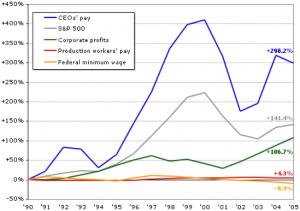
If want the opposite of a Sunday pick-me-upper, go and read Barry Ritholtz on "The Shallowest Generation" about how the self-indulgence of the Baby Boom generation has gotten us into the economic pickle we are currently facing. Not just a rant, the piece has got a bunch of really interesting data, including CEO pay over the last 18 years compared to the stock indices and more importantly, the average worker (see below) as well as a breakdown on what today's biggest consumers spend most of their borrowed money on (hint: eating and drinking seem to be surprisingly high on the list).

I do wish the piece had been a bit more balanced however. After claiming this:

Past U.S. generations invented the airplane; invented the automobile; discovered penicillin; and built the Interstate highway system. The Baby Boom generation has invented credit default swaps; mortgage backed securities; the fast food drive thru window; discovered the cure for erectile dysfunction; and built bridges to nowhere. No wonder we’re in so much trouble.

the author fails to mention that this same Baby Boom Generation gave us the PC, commercialized the Internet, and the mobile phone upon which we're likely to be basing the next big tech boom. In fact, just the other night, David sent me the Wikipedia page on 1970s technology Sinclair boxin response to my complaining about how toys from then just seemed "better thought out." It is really something else to think about the fact that it was Boomers during this era that gave us the PC, the Apple ][, the software industry, and Star Wars!

Still, good to remember that we've got some excesses to undo.

Comments Permalink