(this is page 26 of 121)


Latest

There's an old Hindu saying that comes into my mind occasionally: "For the first 30 years of your life, you make your habits. For the last 30 years of your life, your habits make you."
— Steve Jobs

It would seem that TechCrunch is on a similar wavelength today, thanking Steve Jobs for being such a seminal influence on the tech industry over the last 10 years.

I've got a similar aim, though I want to go further back— quite a bit further back to a time when Steve was not the king of the industry that he is today, but instead, a cocky 29 year old that hadn't been booted from the company he started, hadn't failed publicly, come back, almost died, and given (re)birth to the last remaining big tech company I know which is still truly innovative.

1984 was the year, and Playboy magazine was the venue. The interview is long but well worth reading for two main reasons. First, it is a great picture of the computer industry before consumers had been touched by it, and as such, a fantastic lesson for anyone who has ever struggled to pitch new technology to a mainstream audience. Sort of like watching Obi Wan in movies 1-3— you see the raw talent there without the years of refinement, and as such, it almost looks attainable.

The more important reason why the interview is so good though is because underneath it all, you can still see a beautiful consistency with the same core values that still lead Apple today. Here is the money quote:

PLAYBOY: What's the difference between the people who have insanely great ideas and the people who pull off those insanely great ideas?

JOBS: Let me compare it with IBM. How come the Mac group produced Mac and the people at IBM produced the PCjr? We think the Mac will sell zillions, but we didn't build Mac for anybody else. We built it for ourselves. We were the group of people who were going to judge whether it was great or not. We weren't going to go out and do market research. We just wanted to build the best thing we could build. When you're a carpenter making a beautiful chest of drawers, you're not going to use a piece of plywood on the back, even though it faces the wall and nobody will ever see it. You'll know it's there, so you're going to use a beautiful piece of wood on the back. For you to sleep well at night, the aesthetic, the quality, has to be carried all the way through.

What you see in the Apple of today is the continued adherence to this core belief that by building products for themselves which they would consider "insanely great," the employees at Apple have managed not only to define a nascent industry (personal computing), but increasingly to redefine existing but borked industries. And inspiring us all in the process.

There are all sorts of other great nuggets in this rather long interview for Apple fans, entrepreneurs, and just about anyone who might resonate with the notion of "making a dent in the universe."

Happy Thanksgiving.

Comments Permalink

This past weekend I saw a story on Hacker News about something that has been bothering me more and more over the last two years: our perpetually receding attention span in the digital era.

As I think about my own dwindling attention span over the last couple of years, I can find three main culprits:

1. A big company corporate job: this is a recipe for carving your day into thinner slices than tuna at a cheap sushi bar. I don't come from many meeting heavy work environments so the past two years have been sort of boiling frog phenomenon in that respect. By the time you subtract the meeting time and the context-switching 5-10 minutes on either end, you've sliced your typical 8 hour day into the following array of potentially productive chunks of minutes: (15, 5, 20, 15). And what is worse, you have made yourself into an interrupt-driven machine.

2. Twitter/Facebook/Reddit (stream-based micropublishing): The torrent of "realtime" updates was really cool a couple of years ago when it was new, but lately I've come to realize that it is now the greatest excuse for distraction that was ever created. Linda Stone first wrote about "continual partial attention" a few years ago, mostly in reference to email, IMs, and SMS, but it applies even more so to all of these micropublished updates. The constant barrage preys upon our scarcity-tuned primate brains which convince us that we should never turn away for fear of missing that "next meal."

3. The smartphone: This last one is the most insidious because it slowly but surely takes over all of the white spaces in your life, from waiting at the doctor's office to sitting in line at the grocery store. In my case, I've found that the iPhone has had a great amplifying effect on 1-2 above in that it allows for those activities to be extended to moments when I'm away from the desktop and ostensibly not "at work."

It's too early to tell whether this is all necessarily bad, though it certainly doesn't feel healthy when it comes to intense concentration. Also, the cognitive load exerted by 2-3 is undeniable and makes me wonder the analogy of a PC, ground down by a bunch of background processes, doesn't equally apply to us.
Comments Permalink

Why Chrome OS smells bad

I've not downloaded or attempted the early release of Chrome OS yet, but having read through the docs, I can't help but feel that Google attempting to launch two post-PC operating systems at the same time is only going to confuse partners, consumers, and even developers.

Unless Google gets into the hardware business, it's going to have to depend on large OEMs to ship Chrome OS preinstalled. These are the same folks that took their limited software resources (because even though you might ship billions of dollars of hardware, the razor thin margins mean that you just don't have that much money for software R&D) and bet "big" on Android for everything from phones to slates to netbooks. Now two years later along comes Google saying "Whoops, we didn't really mean that we were excited about you using Android, instead check out this shiny happy new toy!" That one is gonna sting.

Also, no matter how many cute videos Google puts out, consumers are going to be really confused by Chrome OS. Will it have an AppStore? Will it run iTunes? Can it see the shared printer? Share files with the other machines on the network? The smartphone doesn't have any of these affordances (it is, after all, the grandchild of the telephone) so it doesn't disappoint in the same way. And what of the connection to Chrome the browser? The first time someone sees a netbook that runs both Chrome the browser (a fantastic product) and iTunes and then makes the mistake of buying the "webtop only" Chrome OS version, I suspect the Google brand will suffer. Repeat a million times and Google may have to start worrying about its unassailable brand in search.

Finally, developers. The story here is simpler, but not obvious by any means. Chrome OS runs Chrome the browser which means that we're talking about HTML5 applications. But what if we want access to the camera on the bezel (and not through the flash plug-in)? Will the DOM API be extended? Supposedly this is how developers will get access to really important things like the power meter. So now we've got to test for a series of DOM elements that may or may not be present across Chrome runtimes? When you're talking about tens of millions of Chrome the browser instances, do we really want to do this? And the alternative, which is changing Chrome the browser to behave like Chrome the OS from an API perspective seems like a mistake in a world where Firefox, Safari, and IE are still relevant.

So I don't get it. To me it seems like a great example of the netbook distortion effect (NDE): netbooks are so cool looking to fans of Star Trek, Batman, and 24, that they completely obscure their essence as cheap laptops for those that can't afford better and paperweight toys for the rest of us. Meanwhile some IDC clown put out numbers saying that a gazillion netbooks will be sold and boom! You've got folks at Google scheming to kill Windows on this new dark horse.

Sort of like the guys with the cornseed engine for this new killer car called the Edsel.

Comments Permalink

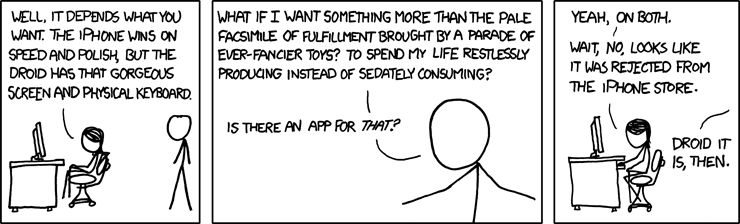
This morning's XKCD really struck a chord with me, not because it is a criticism of Apple's approval process, but because it reminded me of two things I find horribly wrong with this whole "smartphone explosion:"

1. Carriers have replaced banks as the retail presence that is destroying urban areas, and their gross commercialism around getting people to upgrade to the latest and greatest smartphone (and associated $100/month plan) is even more obnoxious than all of the mortgage advertising. Where I live in Cambridge (Harvard Square), the one benefit of the mortgage collapse was the clearing out of all of the banks that seemed to have no trouble paying the jacked up rents that landlords were seeking. But just as quickly as they moved out, Sprint, AT&T, and now Verizon are moving in with giant human-sized replicas of their latest toys, flashy billboards, and sales people handing out flyers to unsuspecting pedestrians on the sidewalk (people they are smartphones not raves!). And no matter where I travel: New York, San Francisco, Chicago, the same blight is visible everywhere.

2. If these devices really are the future of personal computing, it's a little sad to see how much of the positioning is around consumption: listening to music, downloading movies, playing games, reading reviews— and how little of the value expressed seems to be around creating or producing interesting content and data from a mobile device. I love the line in the comic about the stick man who wants to spend life "restlessly producing instead of sedately consuming" for this very reason, because it gets right to the heart of what seems to be just off about putting so much computing power and possibility into users' pockets only to expect them to never again miss "Desperate Housewives" while on the move.

Comments Permalink

A little while ago when the Twitter docs leaked out on the Internet, those poor guys were raked over the coals for writing (in an internal-only document) that their vision was to become "the pulse of the planet."

While I applaud the grand nature of it, I think it is highly unlikely if only because it would require everyone, and a lot of "things" as well, to start actively entering these little status updates as more than marketing signals or social gestures.

I do think though that the Internet is going to eventually bring us "the pulse of the planet—" it's just that that pulse won't be generated actively by humans any more than we consciously generate our own internal heartbeat. Instead, we're probably looking at billions of network-connected sensors, each passively monitoring some very narrow metric, and streaming its data over the Internet.

And right at the center of this sensor soup I think we'll find MEMS technology. The acronym stands for "Micro Electrical Mechanical System" which is a fancy way of describing a silicon-based motion sensor that is so accurate that it can sense your heartbeat just by sitting on the tip of your finger.

Think of a backyard trampoline with a giant level (of the sort you use to hang paintings) right in the center of it. Now shrink that down by several orders of magnitude and connect the level to a digital output and you've got the gist for how MEMS work. Oh, and did I mention that because they are made by the same process that Intel uses to make chips, they are cheap and on a joyride called Moore's law?

Surprisingly, MEMS manufacturing has a lot in common with inkjet manufacturing (the topic of a much longer blog post), which means that we've got some of the deepest pool of expertise in how to do it right, as the Register reported yesterday. Of all of the technologies I've seen in my two years here, none is as mind-blowingly exciting as what the engineers working on it, or as potentially world-changing.

It's funny to think that when it comes, the "pulse of the planet" is likely to be a close relative of the inkjet printer!

Comments Permalink